
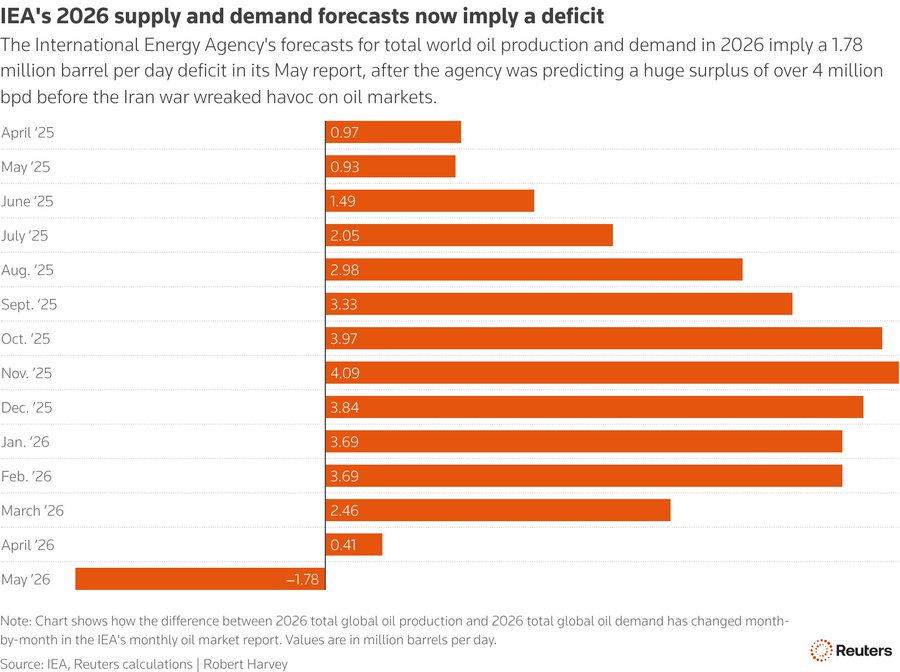
Global oil inventories have reportedly fallen by nearly 10% in just three months as disruptions tied to the Strait of Hormuz continue to pressure global energy markets.
Before the conflict escalation, the Strait of Hormuz handled approximately 20 to 21 million barrels of oil per day, representing nearly 20% of global oil consumption. According to EIA data, total oil and liquids flows through the strait dropped from 20.7 million barrels per day in Q4 2025 to 14.6 million barrels per day in Q1 2026. Crude and condensate flows alone declined from 15.2 million barrels per day to 10.7 million barrels per day during the same period.
At the same time, Saudi Arabia, Iraq, the UAE, and Kuwait reportedly reduced combined production by around 6.7 million barrels per day due to Hormuz-related disruptions.
Energy Intelligence estimates global inventories declined by roughly 230 million barrels in March, 553 million barrels in April, and at least another 200 million barrels in May, bringing the total inventory draw close to 1 billion barrels within three months.
The International Energy Agency (IEA) recently warned that the market could remain severely undersupplied through at least October, even if geopolitical tensions ease sooner than expected. Analysts also caution that rebuilding depleted inventories could take years and may require sustained surplus production well beyond current market capacity.