
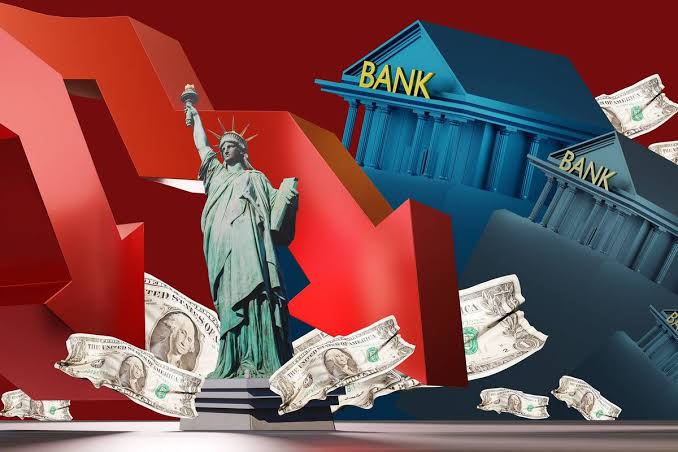
The escalating confrontation between the United States and Iran is no longer confined to geopolitics,it has become a first-order financial variable. Its transmission mechanism is fast and direct: from geopolitical risk to oil, from oil to inflation, from inflation to bond yields, and ultimately into the pricing of nearly every financial asset.
In recent days, oil prices have surged sharply amid disruptions to supply routes through the Strait of Hormuz. At the same time, Federal Reserve officials have acknowledged that the balance of risks is increasingly skewed toward inflation due to the conflict. This shift has forced markets to reprice rate expectations, significantly reducing bets on near-term rate cuts.
The Federal Reserve now faces a complex dilemma. If it leans more aggressively into hawkish policy to counter energy-driven inflation, it risks tightening financial conditions at a fragile moment, when funding costs are already elevated and risk appetite is deteriorating. On the other hand, signaling early flexibility could undermine its credibility by suggesting a tolerance for higher inflation, especially after oil prices climbed from around $75 in late February to above $100 in March.
However, the greater risk may not lie in inflation alone, but within the U.S. Treasury market itself. Widely regarded as the deepest and most liquid market in the world, recent indicators point to a notable deterioration in liquidity conditions. Volatility has increased, bid-ask spreads have widened, and there are signs of sustained selling pressure from some foreign official holders.
This development is critical. Disruptions in the Treasury market do not remain isolated, they quickly transmit into broader financial conditions, affecting funding costs, mortgage rates, credit markets, and overall risk sentiment. Indeed, Treasury yields have risen alongside mortgage rates, both reaching multi-month highs.
Against this backdrop, the most plausible scenario is not an immediate rate cut, but rather a form of targeted, “stealth easing.” The Federal Reserve possesses tools that allow it to stabilize funding conditions and support market functioning without explicitly pivoting toward a looser monetary stance.
Among these tools are the Standing Repo Facility, designed to provide liquidity to eligible counterparties and relieve upward pressure in short-term funding markets, and the FIMA Repo Facility, which enables foreign official holders of Treasuries to access dollar liquidity without resorting to outright asset sales.
Additionally, the ongoing regulatory discussion around the Supplementary Leverage Ratio (SLR / eSLR) is far from a technical footnote, it is central to the broader liquidity framework. In 2025, Federal Reserve officials argued that current calibration levels could become binding in times of stress, limiting the ability of large banks to intermediate effectively in Treasury markets. In practical terms, easing these constraints would allow banks to absorb more Treasuries and provide liquidity under pressure, without formally cutting interest rates.
This raises a critical question: does this amount to “financial repression”?
From a classical perspective, particularly in IMF literature—financial repression involves keeping real yields below market levels, often negative, while using regulatory frameworks to create structural demand for government debt. What we are witnessing today does not yet fully meet that definition. However, it could evolve into a modern, softer version if three conditions align: persistently elevated inflation, real yields that fail to compensate investors adequately, and policy interventions, whether regulatory or liquidity-based, that prioritize Treasury market stability over pure price discovery.
For markets, the implications are clear. When geopolitics triggers an energy shock, which then feeds into inflation, and ultimately disrupts Treasury market liquidity, traditional fundamental analysis temporarily loses its predictive power. Liquidity becomes the dominant driver.
In such an environment, risk assets, including equities and cryptocurrencies, are no longer driven purely by earnings narratives or growth expectations, but by a more fundamental question: is the financial system receiving sufficient liquidity to prevent forced deleveraging?
This helps explain why institutions like Morgan Stanley have recently leaned toward U.S. Treasuries and cash as defensive allocations amid rising geopolitical uncertainty.
In conclusion, markets are not just watching the conflict, they are watching how the conflict forces the Federal Reserve to reorder its priorities. If oil prices remain elevated, inflation expectations continue to rise, and Treasury market liquidity stays fragile, the Fed is more likely to intervene indirectly through liquidity and regulatory channels before considering explicit rate cuts.
These interventions may not appear in bold policy statements, but they will be visible in repo operations, regulatory adjustments, yield behavior, and market spreads.
And it is precisely within these details that the real shift in the market cycle begins.