By: Senior Analyst | CRYPTO MAXX
Imagine someone moving a fortune equivalent to a small country's budget in a matter of seconds. That is exactly what happened in the Bitcoin market on October 23, 2026!
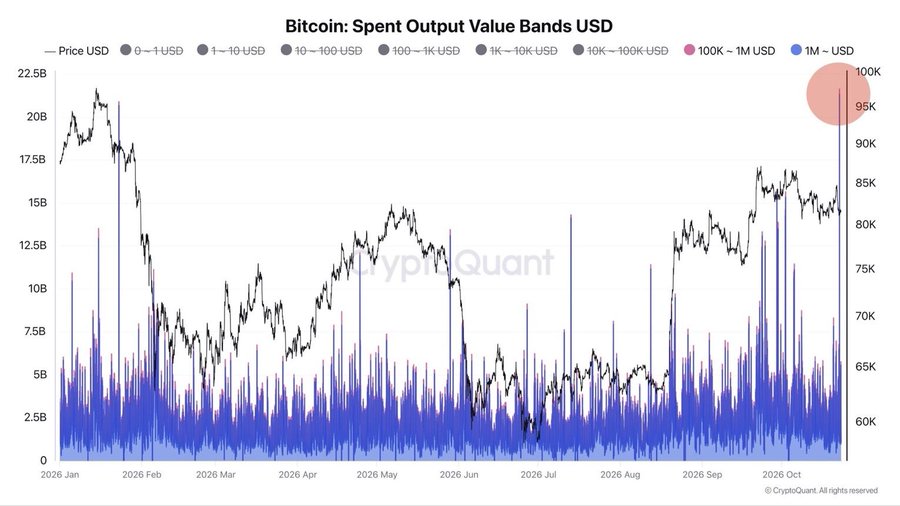
Data from CryptoQuant revealed the recording of the largest on-chain movement so far this year, with over 230,000 Bitcoin—worth more than $21 billion—moved in a single transaction.
Naturally, as soon as this news broke, traders began to panic: "Are the whales selling? Is the market going to crash?"
The short answer is: No. The long answer is the subject of our article today. Let's break down this massive event in simple terms.
🧐 First: How Do We Know They Aren't Selling?
The chart we are showing (Spent Output Value Bands) reveals a massive "red bubble" in October. This bubble means that wallets holding $1 million or more moved their coins.
But here is the good news: These coins were not sent to exchanges (like Binance or Coinbase). They were moved from one wallet to another (Address-to-Address).
In the crypto world, if you want to sell your coins, you send them to an exchange. If you want to keep them safe, you move them to another private wallet. Since this movement didn't hit the exchanges, it means the immediate selling pressure on the market is virtually zero.
📊 Second: What Do the Latest Numbers Say?
The story doesn't end there; the data reveals even more fascinating details:
-
"Sleeping" Coins Just Woke Up: A large portion of these moved coins hadn't moved in months. In fact, about $4.6 billion worth of them had been dormant for 1 to 3 years! These are the "Long-Term Holders."
-
Exchanges Are Facing a "Supply Shortage": At the same time, the amount of Bitcoin held on exchanges has hit cyclical lows (around 2.67 million BTC). This means the available supply for sale in the market is extremely weak.
-
Institutional Whales Are Accumulating: Since the beginning of October, we've noticed massive institutional wallets (like Wintermute) withdrawing thousands of coins from exchanges and moving them to new, untouched wallets.
🤔 Third: If It's Not Selling, Then What Is It?
There are 3 likely scenarios for this massive movement, all revolving around "rearranging the deck" rather than fleeing the market:
· Scenario 1 (Restructuring): A major institution or investment fund is splitting its assets or moving them between its internal wallets for security or regulatory reasons.
· Scenario 2 (Cold Storage): Moving assets to offline "cold" wallets. This means they intend to hold long-term, not sell.
· Scenario 3 (Internal Settlements): Liquidity movements between exchanges themselves or between ETFs for rebalancing.
💡 What Does This Mean for You as an Investor?
This event sends a very clear signal to the market: Large institutional liquidity is moving, but not for the purpose of selling.
The presence of this massive volume of coins off exchanges, combined with low exchange reserves, creates what is known as a "Supply Squeeze." If demand suddenly spikes, it will be very difficult for the market to meet it, potentially driving prices up.
The Critical Point to Watch:
The only risk is if these wallets suddenly decide to move these billions to exchanges in the coming weeks. That is the real red flag to watch. For now, the market looks solid, and whales prefer to stay in the "shadows" away from exchange noise.
The Bottom Line: No need to panic over the big red bubble on the chart. It's just whales tidying up their house. Keep an eye on exchange reserves, and stay calm... until proven otherwise!