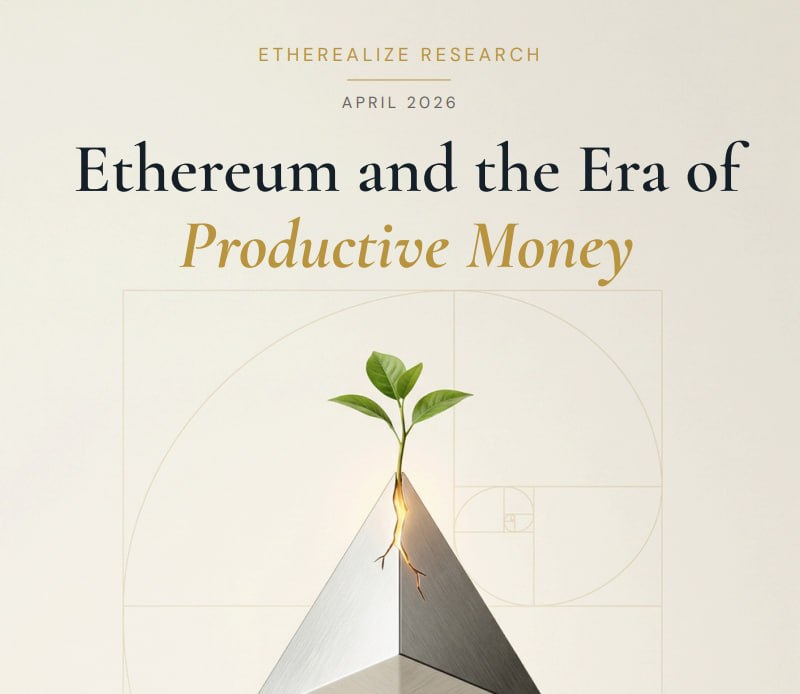
The conversation around Ethereum is no longer confined to technical circles within the crypto community. It has evolved into a comprehensive financial thesis attempting to redefine the very concept of money. The dominant idea in this cycle is that Ethereum may not simply be a digital asset to store or trade, but a new model of “productive money” — money that doesn’t just preserve value, but actively generates it.
This narrative draws strength from Ethereum’s ability to offer a native yield through staking. Investors can participate in securing the network and earn a recurring return without relying on financial intermediaries or third parties. This fundamentally reshapes the investment equation, as returns are no longer solely dependent on price appreciation, but are embedded within the asset itself. In this sense, Ethereum begins to resemble a new asset class — one that blends monetary properties with income-generating characteristics — placing it in a distinctly different category from traditional assets like gold or even Bitcoin, both of which rely almost entirely on price appreciation to deliver returns.
This comparison naturally leads to a deeper discussion about security models. Bitcoin secures its network through mining, a system dependent on financial incentives that diminish over time due to periodic halvings. This raises long-term concerns about sustainability if transaction fees fail to adequately replace declining block rewards. Ethereum, by contrast, operates on a proof-of-stake model, where the cost of attacking the network scales with its market value, and any malicious attempt risks the direct loss of staked assets through slashing. This creates a structurally reinforcing security model, where increased value strengthens network security — a design many consider a meaningful evolution in decentralized systems.
However, Ethereum’s real strength extends beyond yield and security into its functional role within the digital economy. Unlike passive assets, Ethereum is actively used across decentralized finance, whether as collateral for stablecoins, as fuel for executing smart contracts, or as the medium for paying transaction fees. This continuous utility generates organic demand that is not purely speculative, but rooted in actual economic activity. Coupled with the fee-burning mechanism introduced by EIP-1559, which reduces supply during periods of high usage, Ethereum develops a more complex supply-demand dynamic — one that, under certain conditions, may even make it deflationary.
Within this framework, tokenization emerges as one of the most significant future demand drivers. Financial institutions are increasingly exploring the digitization of traditional assets such as bonds, real estate, and equities onto blockchain networks. This trend does not merely add transactional volume; it positions Ethereum as a foundational layer for a new, continuously operating financial system. Each tokenized asset increases network usage, reinforces demand for ETH, and deepens its integration into the evolving financial infrastructure.
That said, this thesis is not without its challenges. The sustainability of staking yields is closely tied to network activity, meaning any slowdown in usage could directly impact returns. Competition from alternative blockchains offering lower fees or higher throughput may also pressure Ethereum’s market share. Regulatory uncertainty remains another critical factor, particularly regarding how staking rewards are classified, which could influence institutional participation.
As for the more ambitious price projections — such as Ethereum reaching hundreds of thousands of dollars — they are fundamentally theoretical, based on the assumption that Ethereum captures a significant portion of the monetary premium currently held by assets like gold and Bitcoin. Historically, however, financial transformations tend not to occur through complete displacement, but through gradual capital reallocation, where multiple assets coexist and share roles rather than replace one another entirely.
Taken together, Ethereum appears to be at a pivotal moment. It is no longer just a technological experiment or a speculative instrument, but a potential cornerstone of a new digital financial system. The question is no longer whether it will grow, but whether the market has already begun repricing it according to this new paradigm. The answer is still unfolding, but what is clear is that this shift extends beyond a typical market cycle — it may represent a deeper transformation in the nature of money itself.