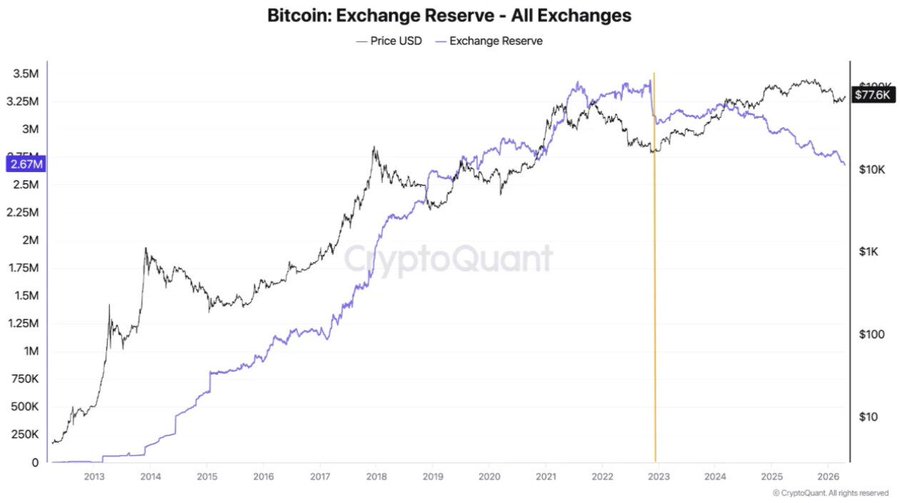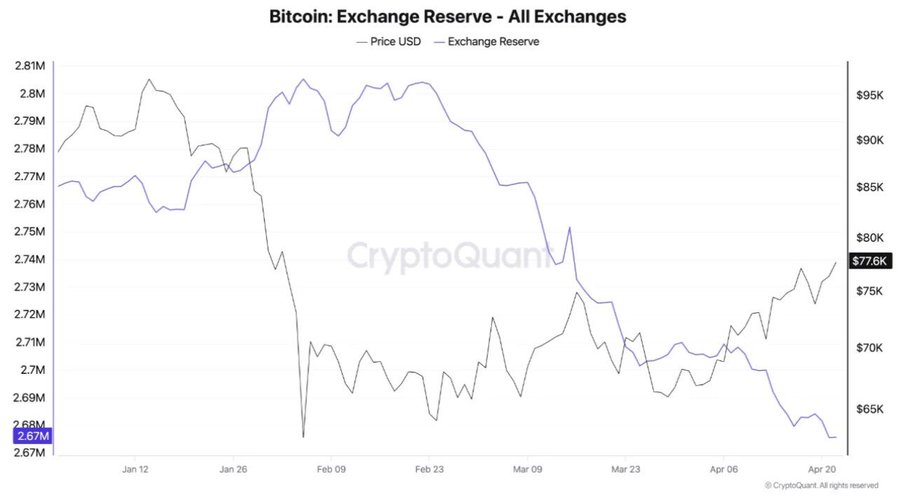

In recent weeks, the narrative of an impending “supply shock” in Bitcoin has gained significant traction across the crypto market. The argument is largely driven by data showing a steady decline in Bitcoin reserves on exchanges, alongside aggressive accumulation by whales and institutional players.
But the critical question remains:
Are we truly entering a phase of structural scarcity that will drive prices higher, or is the market still missing a key component?
Declining Exchange Reserves: What Does It Really Mean?
On-chain data indicates that Bitcoin held on exchanges has dropped to multi-year lows. At first glance, this is widely interpreted as bullish:
Fewer coins available for immediate sale
Reduced potential selling pressure
Higher sensitivity to demand spikes
However, this interpretation requires nuance.
A decline in exchange reserves does not mean Bitcoin supply has disappeared. It simply means that supply has shifted elsewhere, such as:
Cold storage wallets (long-term holding)
Institutional custodians
Derivatives platforms instead of spot markets
In essence:
Supply hasn’t vanished — it has become less liquid.
Whale Accumulation: Strong Signal, Not Absolute Control
Reports of whales accumulating hundreds of thousands of BTC in a short timeframe are undeniably significant. Historically, this kind of behavior tends to support bullish mid- to long-term outlooks.
However, it’s important to remain grounded:
Whales are not always perfectly timed
They react to liquidity conditions, not just strategy
They amplify trends more than they create them
In other words:
Whales influence the market, but they don’t fully control it.
Is a Supply Shock Inevitable?
For a true supply shock to occur, two conditions must be met:
- Reduced Liquid Supply
This condition appears to be in place.
- Strong, Sustained Demand
This is where uncertainty remains.
So far, there is limited evidence of a decisive return in demand, particularly from:
Retail investors
Consistent fresh capital inflows
Spot-driven buying (rather than leveraged speculation)
Without demand:
The market risks entering a low-liquidity, high-volatility environment without clear direction.
The Paradox: Lower Supply Can Increase Risk
Contrary to popular belief, reduced liquidity doesn’t guarantee upward movement. In fact, it can lead to:
Sharper price swings in both directions
Faster drawdowns due to lack of buyers
Increased sensitivity to large sell orders
Put simply:
The market becomes more fragile — not just more bullish.
What Actually Matters Now?
Rather than relying on narratives, the focus should shift to key market indicators:
Spot Volume vs Derivatives Volume
Is real buying leading the move?
Funding Rates
Are they reflecting healthy demand or excessive leverage?
Open Interest + Price Action
Is new money entering the market?
ETF Inflows (especially U.S.-based)
Are institutions adding sustained capital?
These metrics provide a clearer picture of whether the market is building momentum… or simply compressing before volatility.
Final Take
Yes — the decline in exchange reserves combined with ongoing whale accumulation is structurally bullish over the medium to long term.
But no — this alone does not guarantee an imminent breakout.
Bitcoin doesn’t move higher because supply is low.
It moves higher when buyers are willing to pay higher prices.