
For more than 150 years, financial markets have repeated the same cycle: a revolutionary industry captures investor imagination, capital floods into a small group of dominant companies, valuations soar, and eventually the market reaches dangerous levels of concentration.
Today, many analysts believe artificial intelligence may be creating a similar pattern.
A small group of AI and technology giants — including Nvidia, Microsoft, Apple, Amazon, Meta, Alphabet, Broadcom, AMD and TSMC — now drives a massive share of global market gains.
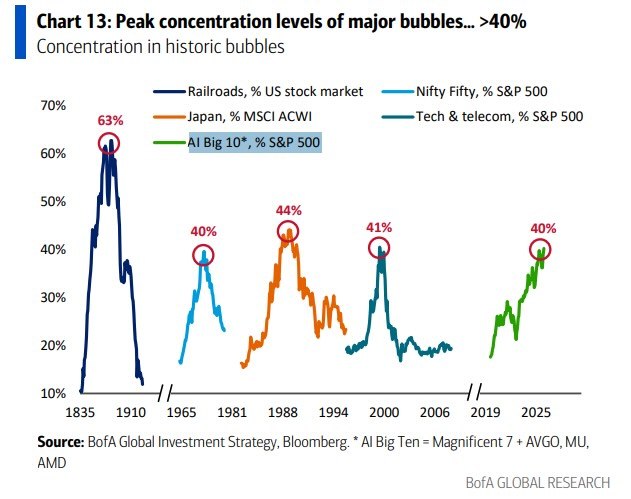
Together, AI-related companies represent roughly 40% of the S&P 500, a level historically associated with previous market bubbles.
The pattern has appeared several times throughout modern financial history.
In the late 1800s, railroad companies became the dominant force in the U.S. stock market. Investors believed railroads would permanently reshape the economy, and valuations climbed rapidly.
But after the Panic of 1873, railroad stocks collapsed, banks failed and the United States entered a prolonged economic depression.
Nearly a century later, the “Nifty Fifty” era produced another concentration bubble. During the late 1960s and early 1970s, investors poured money into a small group of elite growth companies that were viewed as unstoppable.
These stocks eventually represented about 40% of the S&P 500. When inflation surged and interest rates rose, the market crashed, sending many of those companies into steep declines.
Japan experienced a similar boom during the late 1980s. Japanese equities grew to nearly 44% of the global stock market as real estate and stock speculation intensified. At the peak, the Nikkei traded at extremely high valuations before the bubble finally burst. The index later lost more than 80% of its value, and Japan faced decades of economic stagnation.
Then came the dot-com bubble. By 2000, technology and telecom companies dominated financial markets as investors rushed into internet-related businesses regardless of profits or revenue. Many firms traded at extreme valuations based purely on future expectations. When sentiment shifted, the Nasdaq collapsed nearly 80% between 2000 and 2002.
Today, artificial intelligence has become the market’s newest growth story.
Massive amounts of capital continue flowing into AI-linked companies through ETFs, passive index funds, retirement accounts and AI-focused investment products. Investors increasingly view AI as the foundation of the future global economy, much like railroads, Japanese assets and internet companies were once viewed in earlier eras.
At the same time, concerns are growing about concentration risk. Markets are becoming increasingly dependent on a handful of companies continuing to deliver exceptional growth and earnings performance. If expectations weaken, the broader market could face significant pressure.
History does not guarantee that a crash is imminent. However, previous bubbles demonstrate that when too much market power becomes concentrated in a very small number of companies, financial risk across the system rises sharply.
Whether AI becomes the next technological revolution or the next major bubble remains one of the biggest questions facing investors today.